As a junior doctor in a rural Kenyan hospital, Dr. Faith Osier often had to look mothers in the eye and say those heartbreaking words. Many children in the pediatric ward died of malaria , sometimes just hours after they had been sitting up and laughing. One by one, the mothers would quietly wrap their child in cloth and begin the long, devastating walk home. “When I look back now, it’s those moments that stayed with me,” Dr. Osier says.
Growing up in a middle-class, urban environment between Nairobi and Mombasa, Dr. Osier was insulated from the scourge of malaria. But beginning her career in that hospital in the Kilifi District opened her eyes. “That’s when the gravity of malaria hit me,” she says. “I would be on the shop floor treating all these patients with malaria and thinking, ‘But if I could just develop a vaccine, then they wouldn’t even come in the first place.’” She was also impressed by the malaria researchers at the hospital who were urgently working to better understand the disease.
Dr. Osier always knew she wanted to go into medicine—like a friend of her mother’s who was a doctor. “For many of us, our careers are shaped by what we see,” she says. “I was lucky enough that there was a female doctor I could look up to.” She later learned that her role model wasn’t just treating patients, she was studying neglected tropical diseases .
But as a young pediatrician, Dr. Osier hardly saw a clear path to becoming a disease researcher herself, given the limited opportunities for female doctors in Kenya to pursue specialist training. Growing up in a middle-class, urban environment between Nairobi and Mombasa, Dr. Osier's world was entirely insulated from the raw devastation of malaria. But that would soon change.
After medical school, she began her career in what was then the Kilifi District in Kenya. “That’s when the gravity of malaria hit me,” she says. There weren't just a few isolated cases of malaria; there was an entire ward of sick children.
Dr. Osier knew she wanted to dedicate her career to fighting malaria to prevent children from dying and families and communities from contracting the deadly disease. She sought out the opportunity to receive specialist clinical training in Kenya and the UK, earning a master’s degree in immunology and a Ph.D. in Life Sciences. In the ensuing years, she has held research, faculty, and scientific leadership positions around the globe, from Australia and Kenya to Germany and the UK, where her posts currently include co-director of Imperial College London’s School of Convergence Science for Health and Technology , and Director of the Imperial Chanjo Hub .
“ Malaria transmission is different in Africa ,” Dr. Osier says, “and it’s because of the geography and climate.”
Malaria is caused by a parasite transmitted to humans by infected mosquitoes. Sub-Saharan Africa bears the heaviest burden of Plasmodium falciparum , the deadliest form of the parasite. Warm temperatures and long rainy seasons create ideal conditions for mosquitoes to breed and thrive, increasing the risk of transmission. In 2024, Africa was home to 95% of the world’s malaria cases and malaria deaths, according to the World Health Organization. The disease claimed 600,000 lives globally that year, three-quarters of them children under age 5. And while geography and climate played a significant role in these numbers, Dr. Osier says that malaria is also a disease of poverty.
“When you go out into the rural areas, some people don’t have decent housing,” she says. “So sometimes you’re giving a [bed] net to someone who doesn’t have a house.” Other factors, like overcrowding, poor sanitation, and poor road construction, create perfect breeding grounds for mosquitoes.
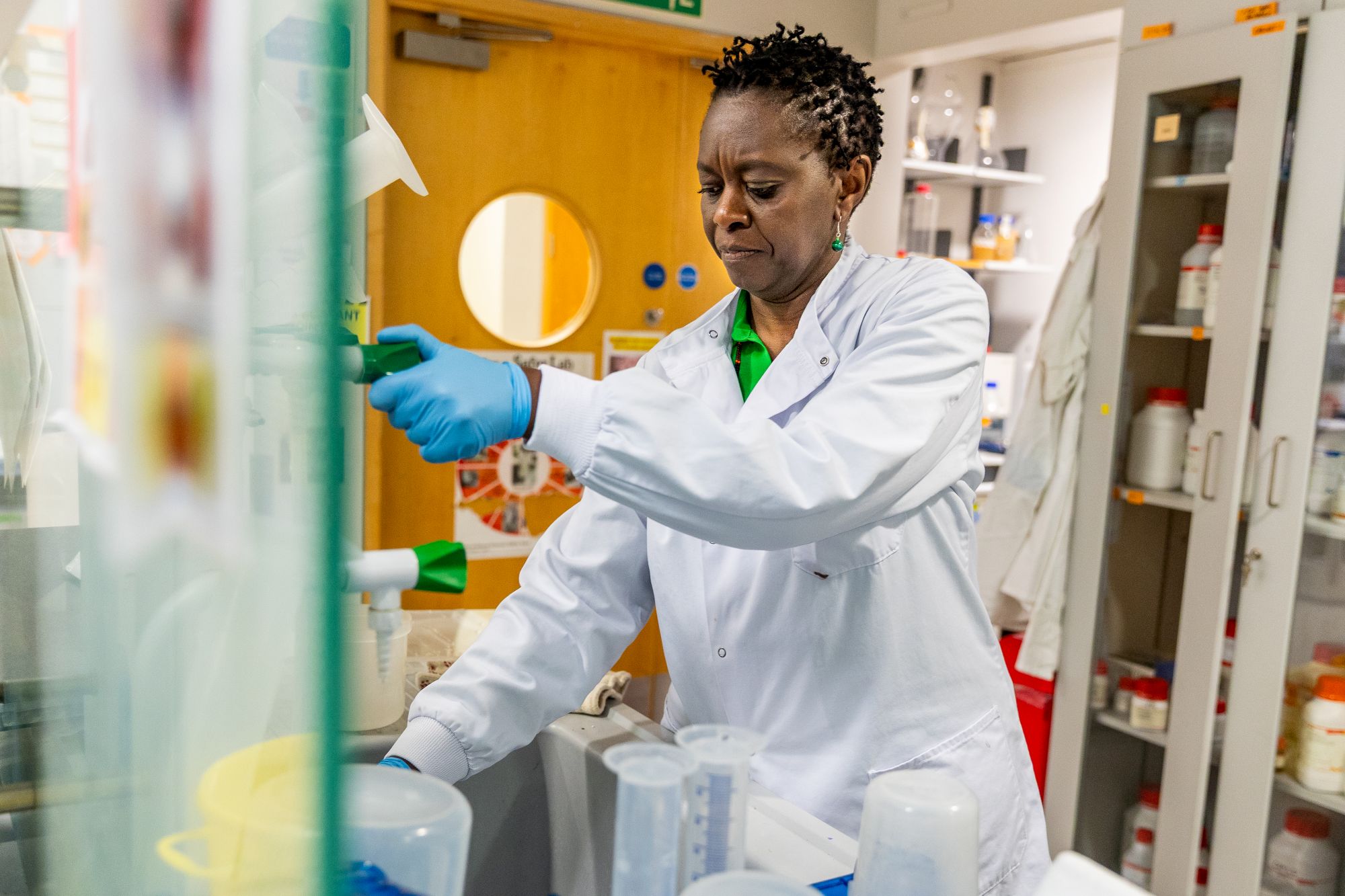
The traditional approach to developing vaccines against infectious diseases is rudimentary compared to the complexity of malaria. While many viruses or bacteria have simpler genomes with just a handful of proteins for our immune systems to target, the malaria parasite is more complex with multiple life-cycle stages, its genome encodes thousands of proteins and it has expert ways of evading immunity.
Fortunately, molecular technology has advanced dramatically in recent years. When the first genome of a malaria-causing parasite was published in 2002, researchers finally had a detailed picture of what they were up against. “That’s when we understood,” says Dr. Osier. “We’d been counting maybe 10, 20 proteins. There are actually over 5,000 proteins there. But you couldn’t see them before, because you didn’t have the tools.”
That complexity explains why, even as the malaria field has made meaningful progress, so much remains to be done. Two vaccines, RTS,S and R21, have been approved in the past few years and are reaching children across Africa, but both target just one stage of the parasite’s complex life cycle. Dr. Osier’s work aims to go further, using newer technologies and sophisticated immunological analyses to design a vaccine that targets a different stage, potentially offering stronger and longer-lasting protection.
Developing a vaccine can take years, even decades, with obstacles and failures along the way. But Dr. Osier takes the long view. “There are setbacks in work, but there are also setbacks in life,” she says. This has been true in her own life—particularly her experience of enduring multiple miscarriages. “That was a big setback and helped me to appreciate that life happens,” she says. “Life doesn’t respect that you’re a doctor or that you’re researching this great disease. Life is just life, and you must pick yourself up and keep moving every time you fall down.”
Dr. Osier’s scientific approach is to match the complexity of the disease. She started by focusing on an undeniable truth she observed in the rural hospital: The adult wards weren’t full of malaria patients.
“In the exact same house, a child will be at death’s door, but the mom and dad are completely fine,” she says. “That means immunity is possible.”
Understanding how that immunity works has been a yearslong undertaking. “The malaria parasite is like a massive Rubik’s Cube,” she says. “There are millions of bystander antibodies just hanging out, doing nothing. But there are a few that really do the business.”
Her team’s breakthrough advances have come from using cutting-edge protein microarray technology to pinpoint exactly which antibodies are doing the work. That led to several years of work on identifying antigens that were potential vaccine candidates.
But then the COVID-19 pandemic hit, hampering Dr. Osier’s research. Even worse, Africa was among the last parts of the world to get access to COVID-19 vaccines, which were developed and manufactured in high-income countries. “During the pandemic, we had vaccine nationalism where rich countries were stockpiling vaccines,” Dr. Osier says. She began to ask herself, “How could I use my knowledge more broadly beyond malaria?” She applied for and was awarded a grant to build vaccine manufacturing capacity in Africa, for multiple diseases.
Dr. Osier’s story underscores a critical truth in global health: The people closest to the problem are the ones best equipped to solve it. She knows this better than anyone. While pursuing her doctorate, she learned about the variability of malaria across the African continent. “Malaria doesn’t have the same face everywhere,” she says, “so when trying to interpret your antibody response, you have to take into account that variability.” She believes strongly in local R&D and equipping local scientists with the skills they need to respond to an epidemic or outbreak in their own community.
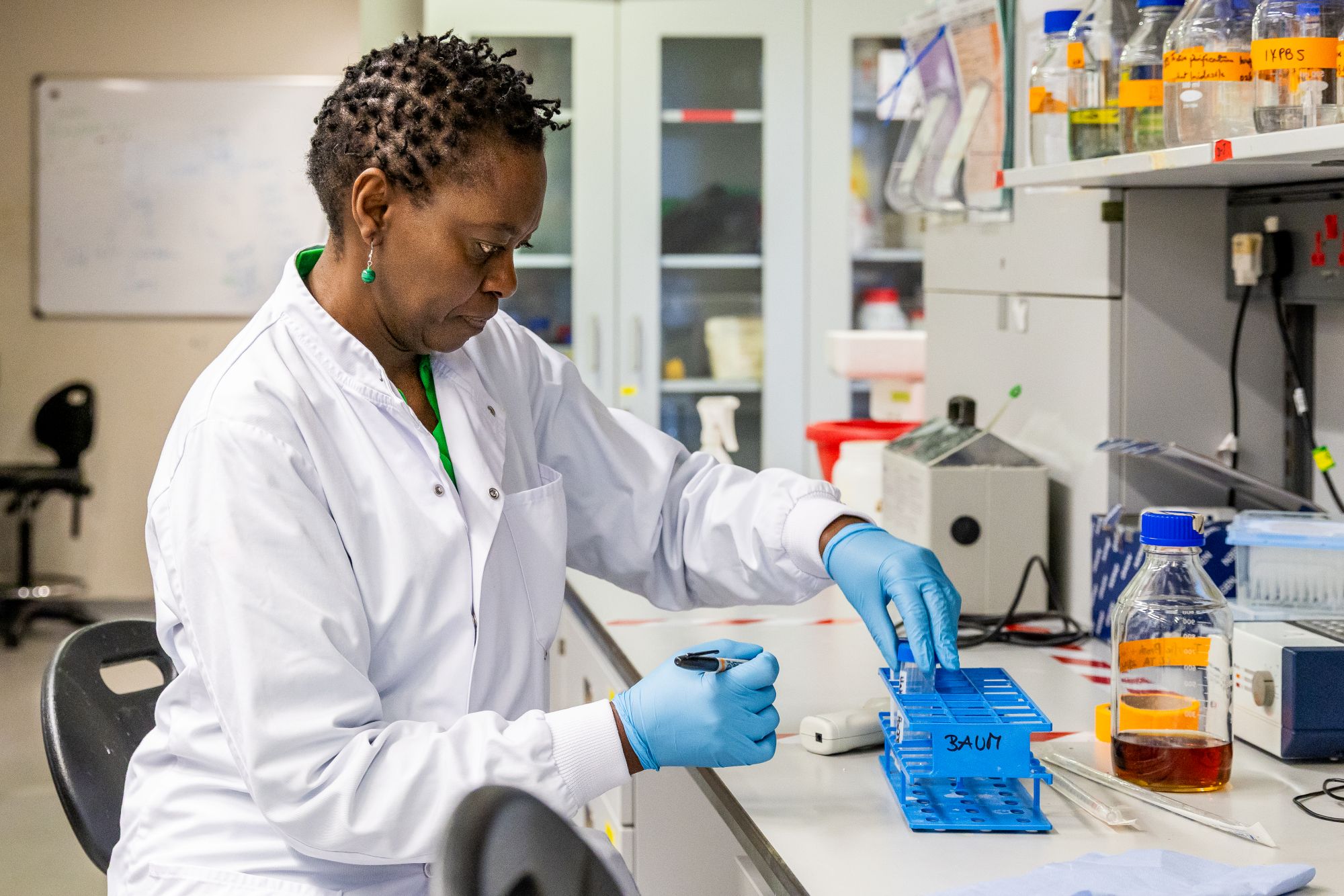
Dr. Osier envisions an “army of African scientists ” working in concert to advance health innovation across the continent. “You need many people working on the same problem, pushing against each other, and that’s when a solution will emerge,” she says. “We need the Africa to be teeming with scientists.”