Dr. Polycarp Oyoo will never forget his first encounter with postpartum bleeding—the leading cause of maternal deaths worldwide.
As a young doctor, he helped a Kenyan mother deliver twins at a facility without electricity during a powerful storm. Despite the darkness and thunder, all seemed well—until the second child was followed by a frightening torrent of blood.
“The moment you see the blood gushing out,” Dr. Oyoo recalls, “you panic as a healthcare provider because you’ve never seen that amount of blood [during a birth].” He frantically contacted a doctor and midwife at another hospital, who talked him through managing the crisis. “We saved the mother and the twins,” he says. “They are now very old!”
The global toll of postpartum hemorrhage
Tens of thousands of women around the world aren’t as fortunate. Postpartum hemorrhage (PPH)—defined as losing more than half a liter of blood within 24 hours of childbirth—affects 14 million women every year and kills 70,000, primarily in low-income countries. That’s one death roughly every six minutes.
“It is so sad when women walk into the clinic expecting to leave joyous and happy,” says Dr. Oyoo, “but instead they leave sorrowful, or don’t leave at all. That motivated me to focus on preventing maternal deaths, because even one lost life is just too many.”
PPH, he says, “is a monster that can be slayed, because we know its weaknesses and how to handle it.”
How early detection saves lives
Today, Dr. Oyoo works at Kenya’s International Center for Reproductive Health, where he trains doctors and nurses in emergency care for mothers and newborns. His work follows the E-MOTIVE protocol—a set of proven best practices developed through a study in African countries with high maternal mortality rates.
E-MOTIVE is a memorable acronym outlining the key steps to manage PPH. The first—and most critical—“E” stands for early detection. PPH is often difficult to diagnose, especially in low-resource settings like rural hospitals without electricity. In busy maternity wards, it can be hard for doctors to tell when blood loss crosses the danger threshold.
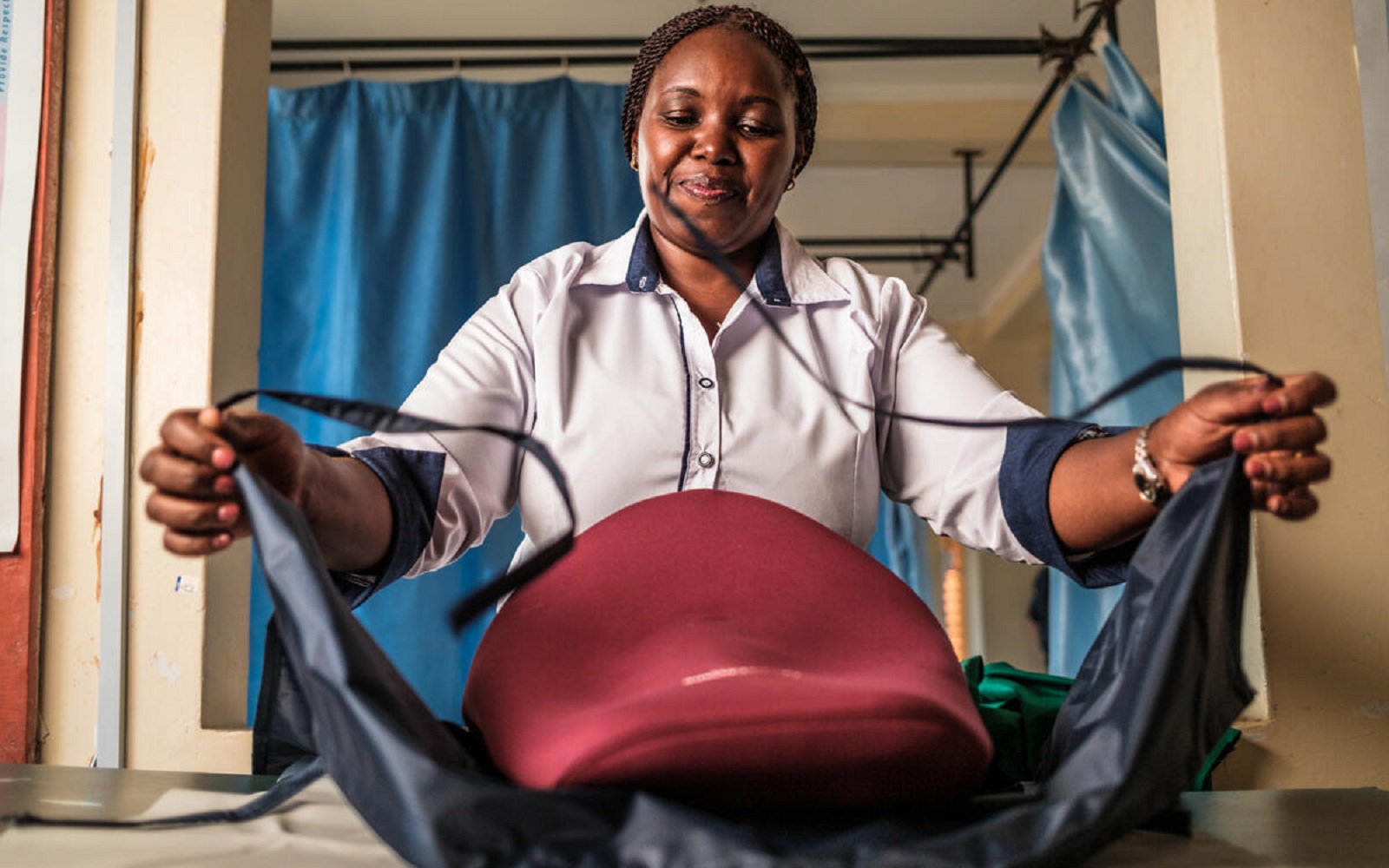
To solve this, the E-MOTIVE protocol recommends a simple, life-saving innovation: the PPH drape. It funnels a mother’s blood into a V-shaped plastic bag with measurement markings, giving health workers an accurate, real-time reading of blood loss—no guesswork required.

Scaling solutions across Kenya—and beyond
Along with early detection, Dr. Oyoo trains healthcare workers in five additional interventions to stop excessive bleeding: uterine massage (M), oxytocic drugs (O), tranexamic acid (T), IV fluids (IV), and genital-tract examination (E). “So far,” he says, “I’ve been able to reach almost half the counties in Kenya—and the people I’ve trained have trained others.”
These interventions are saving lives. “We’ve seen a staggering 60% reduction in severe bleeding,” notes Dr. Oyoo, in clinics using the E-MOTIVE approach. Still, he’s not done. “No [mother] deserves to die while giving birth,” he says. “[Birth is] a process that gives life and it shouldn’t result in death.”
More on women’s health
Return to Women’s health innovations · A doctor at the intersection of women’s health and economic power · Could this be a transformative year for women’s health?