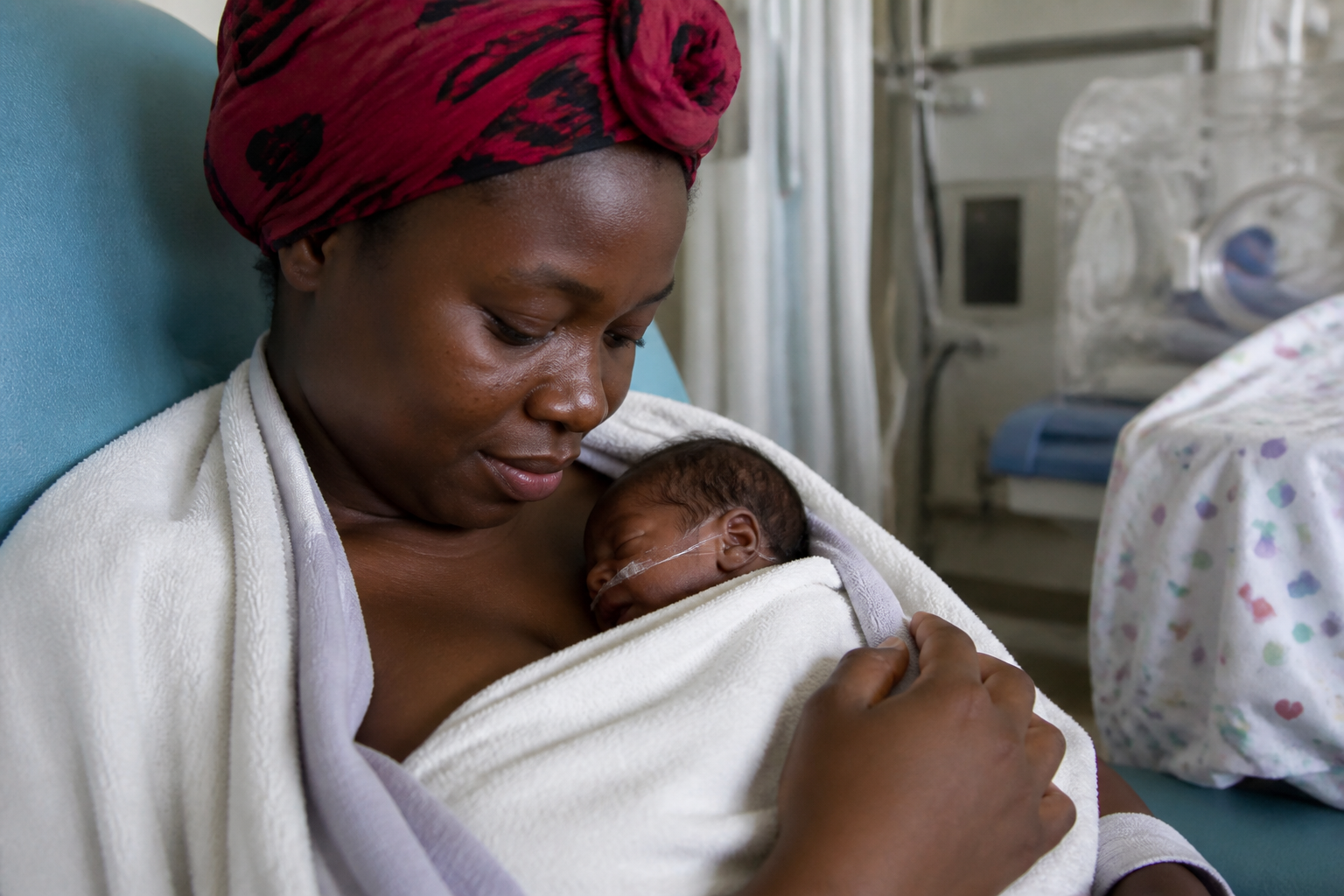
The newborn wriggled as she was lowered onto her mother’s chest, minuscule fists clenched, eyes fluttering, chest softly rising and falling. As a nurse wrapped a binding around the pair to steady the tiny body, the baby snuggled into her mother’s skin. The mother began to weep.
“I quickly asked her if she was all right,” says Dr. Sugandha Arya. “The baby had been born 48 hours earlier and immediately taken away to the NICU. She was crying because this was the first time after giving birth that she’d ever touched her baby.”
“She was crying because this was the first time after giving birth that she’d ever touched her baby.”Dr. Sugandha AryaNew Delhi Clinical Investigator for iKMC India · Safdarjung Hospital
From “standard” to “immediate”
As a result of the clinical trial, the World Health Organization issued new guidelines in November 2022 advising that all preterm and low-birthweight babies have immediate skin-to-skin contact with a caregiver after birth—without any initial time in an incubator, irrespective of the baby’s birth weight, gestational age, or stability.
That marked a significant change from earlier guidance, which called for preterm babies and mothers to be cared for by different departments in separate hospital sections. With immediate KMC, they are kept together in the same area, allowing for continuous skin-to-skin contact and integrated care from an integrated medical team.
“No change comes without challenges,” says Dr. Pratima Mittal, who was involved with the clinical trial when she was the head of the obstetrics department at Safdarjung Hospital. During that time, she oversaw necessary adjustments to the hospital’s physical spaces for women in labor, as well as updates to procedures affecting labor and delivery patients—including infection prevention practices, policies, and personnel.
What made it all work, says Dr. Mittal, was the commitment of hospital leaders as well as good communication and training. “Strong leadership is very important,” she says. In this case, that meant clear alignment among the heads of the neonatology and obstetrics departments and the medical superintendent.
There was some initial apprehension as the trial began, but Dr. Mittal found that the positive results soon became a strong motivating factor. Now that the trial has concluded, the motivation is even stronger.
“The existing evidence is very, very robust. We can depend on it.”Dr. Pratima MittalHead of Obstetrics and Gynecology · Amrita Hospital
Shifting the paradigm of care
Dr. Nitya Wadhwa also notes the importance of evidence. A senior professor at the Translational Health Science and Technology Institute, she supported trial protocols, guidelines, research, and data at the trial site in India. She says the neonatal nurses involved in the trial were initially apprehensive and “talked about how much extra work this would be.” But as the trial progressed, their apprehensions vanished. Immediate KMC did not translate into more work for them—quite the opposite, since mothers and caregivers were now more involved in the babies’ care. And the positive results were extremely motivating.
Dr. Wadhwa also notes the significance of getting extended families and caregivers involved. “We saw whole families coming in with the mother for delivery,” she says. “And so we had surrogates who could provide the skin-to-skin contact, whether a sister or grandmother.” Further, she saw mothers who had experienced immediate KMC become KMC champions, encouraging other new mothers and families. “It was very heartening,” she says.
That aligns with what Aarti Kumar has seen in her decades of work in newborn care and KMC. As the CEO of the Community Empowerment Lab in Uttar Pradesh, India, Kumar helped lead a study of standard KMC in 2004 and has been a passionate advocate ever since.
Mothers regularly tell Kumar, “The baby doesn’t startle and is sleeping better. I have more breast milk, earlier.” These positive experiences directly correlate with the likelihood that mothers will continue KMC once they get home, she says.
Moving toward a new standard of care
“The bottom line is that skin-to-skin contact should be started as early as possible and continue as long as possible,” says Dr. Wadhwa.
Many hospitals and clinics already implement standard KMC, but a large percentage need updates to their facilities, as well as staff training to embrace and offer immediate KMC. Those updates include redesigned health systems in the form of mother-newborn ICUs that provide care and medical treatment for both mother and newborn with no separation time or distance between them—even if the baby needs additional medical support.
In this new environment, medical staff involve mothers and caregivers in clinical care. What’s more, mothers and caregivers have dignified spaces for cleaning and bathing, are provided nutritious meals, and are heard and supported. Visitor policies also need updating to enhance the participation of caregivers and family members so immediate KMC is a shared responsibility.
Above all, Dr. Arya believes that what’s needed is space in people’s minds. “We need to make ourselves open to change. If you change a mindset, you’ll be able to find answers to all obstacles,” she says.
“We need to make ourselves open to change. If you change a mindset, you’ll be able to find answers to all obstacles.”Dr. Sugandha AryaNew Delhi Clinical Investigator for iKMC India · Safdarjung Hospital